


Email me |
Quick guide to Inheritance
The following diagram shows a class called Bob being extended - the
new class being called "BigBob". In the "Attributes" box, there is a type
followed by the variable name. In the "Method" box there is a return type,
followed by a method name, and any parameters are given in brackets. This
is elementary though - the diagram is to illustrate inheritance from one
class to another.
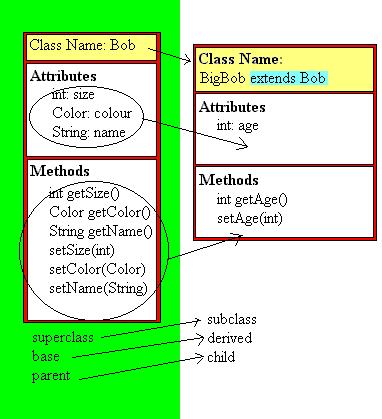 When
a new class extends an old one, the old class is the superclass (or base,
or parent), and the new one is the subclass (or derived class or child).
All of the public attributes and methods possessed by the superclass will
be inherited by the subclass. Notice that the subclass has access to the
superclass' methods and attribute, but the superclass doesn't have access
to the subclass' methods or attributes. When
a new class extends an old one, the old class is the superclass (or base,
or parent), and the new one is the subclass (or derived class or child).
All of the public attributes and methods possessed by the superclass will
be inherited by the subclass. Notice that the subclass has access to the
superclass' methods and attribute, but the superclass doesn't have access
to the subclass' methods or attributes.
Also, through polymorphism, wherever a class of type "Bob" is required,
a BigBob class will be allowed too. If, however, a BigBob is asked for,
because it has more methods and attributes than a standard Bob, only a
BigBob is acceptable. Notice that BigBob only directly inherits from one
other class. This is because Java only supports single inheritance as
opposed to multiple inheritance - only one class may by a class' superclass.
(note that a class may be extended by many other classes though - indeed,
the class called "Object" is the superclass of every class in Java.
Object is the only class that doesn't have a superclass).
|


